Pipeline
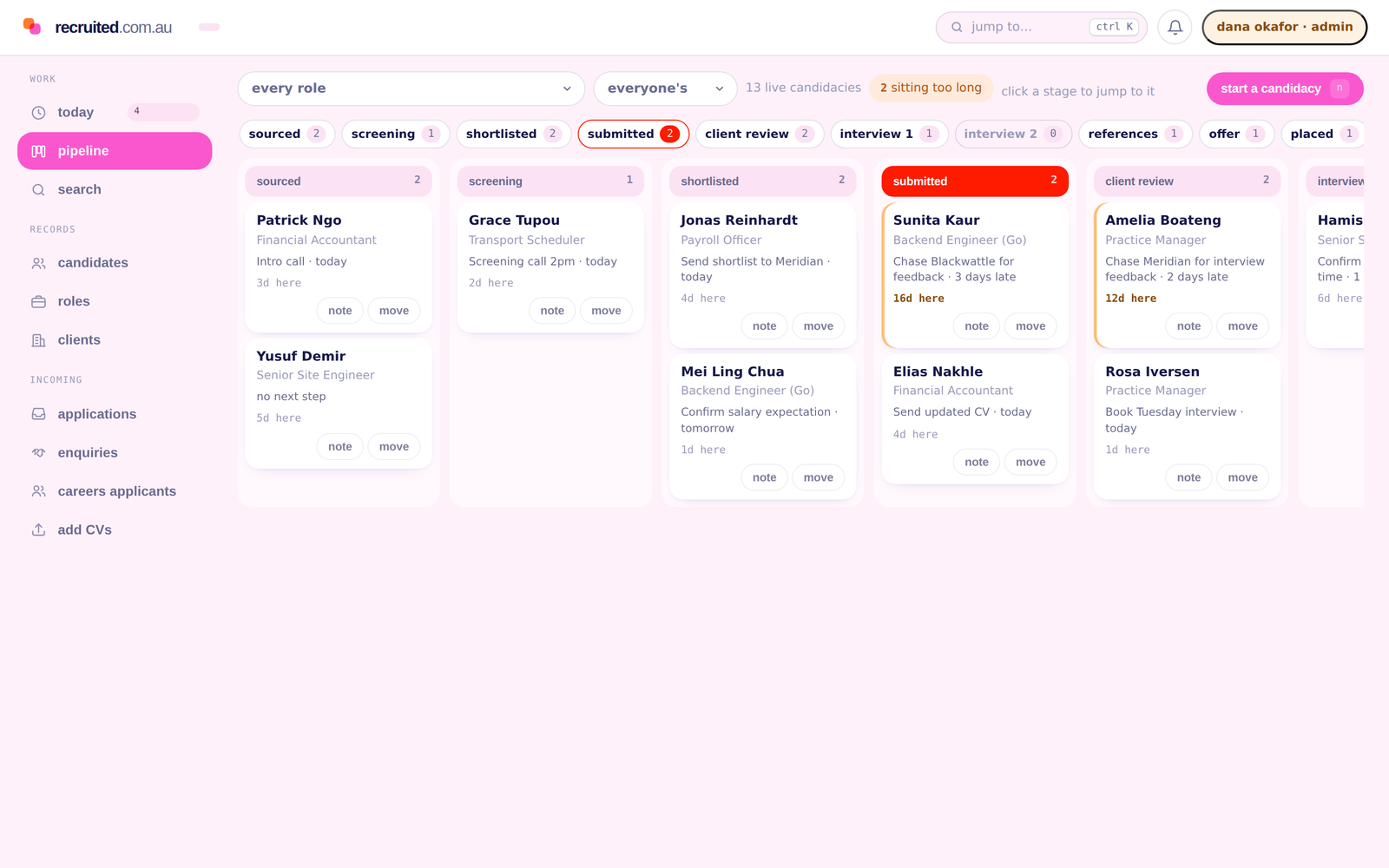
Every candidate moving. Every next action visible.
Movement carries its reason, creates the follow-up and sets the reminder, so the process moves forward and the context moves with it.
What changes
-
Nothing waits on somebody remembering
A stage change creates the next action and its reminder.
-
The reason survives the week
Why a candidate was rejected, why the client went quiet, why this one is on hold. Recorded at the moment it was obvious, available when it no longer is.
-
Handovers stop being lossy
Ownership moves with the history, the reminders and the conversation.
Start to finish
One candidacy, from shortlist to placed.
-
Shortlisted
Added to the opportunity with a note on why. The candidate relationship records that they are being considered, so nobody approaches them about a competing role by accident.
-
Submitted
The client’s clock starts. The submission is recorded with what was sent, the email thread is attached, and the follow-up is scheduled against your response-time promise.
-
Client review
No feedback in two business days creates a chase. No feedback in five escalates to the opportunity owner.
-
Interview and offer
Times, participants and outcomes on the record. Offer risk shows up in the Deal Desk while there is still time to act.
-
Placed, then aftercare
Start date, fee and guarantee period recorded. Check-ins scheduled through the guarantee window.
Three lifecycles, not one
A person is not a stage in somebody’s job.
Systems that collapse everything into one pipeline lose the candidate who was perfect last year the moment that role closes. These run in parallel and stay linked.
The candidate relationship
Where a person is with you, independent of any role: how well you know them, when you last spoke, what they are open to and what they have said no to. It outlives every opportunity they were considered for.
The candidacy
One person against one opportunity, moving through stages that carry their reasons. Sourced, screening, shortlisted, submitted, client review, interview, offer, placed, and the terminal states that matter just as much.
The placement and aftercare
What happens after the offer is accepted: start date, guarantee period, check-ins, the fee, and the follow-through that decides whether the client comes back.
Controls
The rules that keep a board honest.
-
One next action
Every open candidacy has one, or is flagged as having none.
-
Required reasons
On the transitions you will be asked about later.
-
Append-only history
Stage history is a record, not a field that gets overwritten.
-
Keyboard parity
Every move available by pointer is available by keyboard.
Related
Questions
Can I change the stages?
Yes. Stages are configurable per workspace, and a role type that works differently can have its own set. What is not configurable away is that every candidacy has a stage, an owner and a next action.
Can I require a reason to move a candidate?
Yes, per transition. The ones worth requiring are usually rejection and withdrawal, because those are the two you are asked about months later.
Is there drag and drop?
Yes, with a keyboard equivalent for every move it can make.
What happens when something stalls?
A candidacy with no movement and no next action is surfaced on the Today dashboard and in the Deal Desk. Nothing rots quietly at the bottom of a column.
Can I hand a candidacy over?
Yes. Ownership transfers with the history, the next action and the reminders attached.
Does the client see this?
No. The pipeline is internal. What a client sees is what you deliberately submit to them.
Ready when you are
See Recruited on one of your live roles.
A demo against a real role tells you more than a feature list. Bring one, and we will walk it through the platform with you.
We reply within one Australian business day.