Executive search
Executive search software that respects a long relationship.
Retained and contingent assignments on one desk, candidate records that outlast every one of them, confidential roles inside a workspace boundary that is enforced rather than promised, and a search that shows its evidence. Built for Australian executive search firms.
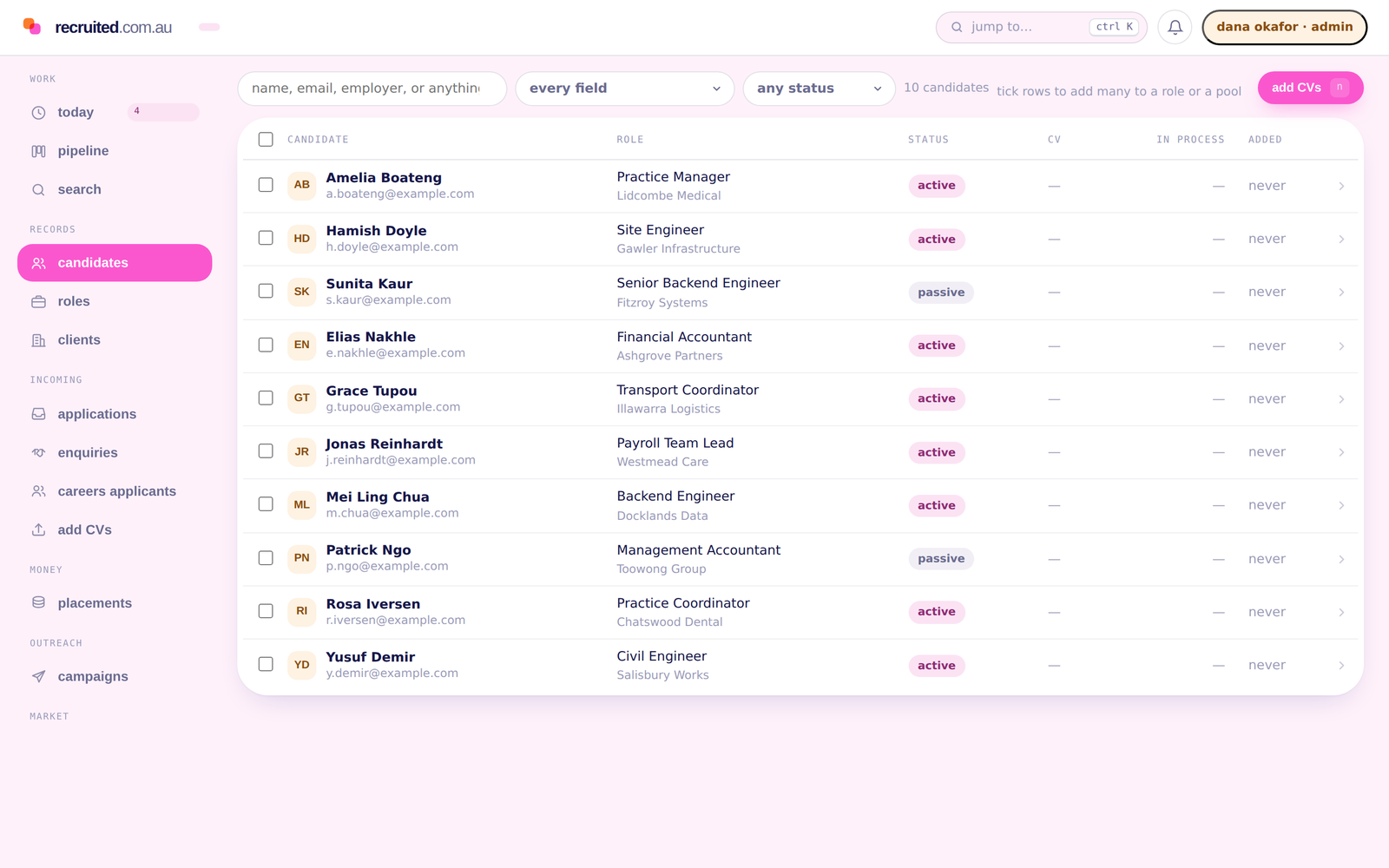
Retained and contingent
Both kinds of assignment, on the same records.
A search firm rarely runs one model. The terms of each assignment sit on the opportunity itself, and the client’s standing terms sit on the client, so a retained mandate and a contingent brief live in the same list rather than in two systems.
On the opportunity
The client, an owner, a reference, the title, discipline, seniority and location, the work type, the salary range, the headcount, and the fee: a percentage and a fee basis written in your own words, whether that is a retained mandate paid in stages or a contingent fee on start.
On the client
A default fee percentage and a guarantee period for that client, applied to each new placement unless you change it. Status as prospect, active, dormant or lost, and every opportunity and placement attached to it.
On the placement
Start date, salary, the fee excluding GST, the fee percentage, and a guarantee that runs from the start date, because that is the clock the client is counting. Then the aftercare stages through to the guarantee completing.
Long-cycle relationships
The same person, across years, without losing the thread.
Executive search is a relationship business with a long memory. The candidate record exists independently of any assignment, so a person you met three years ago is still findable, and the reason it did not happen last time is still on file.
-
A person is not an application
Candidate, opportunity, candidacy, submission and placement are separate records. A role closing ends the candidacy; the candidate relationship continues.
-
The reason survives
A candidacy closes with an outcome and a reason, in words. Withdrew, wanted a different scope, client passed after the second interview. Recorded when it was obvious, available when it is not.
-
When you last spoke is a fact, not a feeling
Every candidate carries a last-contact date, and a search result says how long ago that was. A contact from over a year ago is labelled as likely out of date, rather than ranked as though it were fresh.
-
Consent and preference on the record
Contact permission, channel preference, opt-outs and the source of consent are fields on the person. Being found in a search never makes someone contactable; contacting them is a separate, deliberate action.
The applicant tracking system page walks through the same person across three years, from an application through a near miss to a placement.
-
Pools that fit a search practice
A pool can be curated by hand or defined by a saved query that is evaluated when you open it, so it is never a stale list wearing a live name. Kinds include shortlist, nurture, availability and alumni.
-
The timeline is on the person
Email, calls, meetings and notes attach to the candidate, whoever at the firm had the conversation and from whichever connected mailbox. A summary cites the message each line came from.
-
Ownership without hoarding
Records have owners and the owner can change. When a consultant leaves, their mailbox connection ends and the history they contributed stays.
Confidential search
Confidentiality that is enforced in code, and recorded.
A confidential assignment has three audiences to keep apart: the client’s own market, the candidate’s current employer, and everyone at your firm who is not on the search. Each of these controls is implemented and described on the security page; none of them is a policy document.
-
One workspace boundary, decided in one place
Every query carries your workspace, the filter lives in one module, and no role, including an administrator, can see across it. A session with no workspace sees an empty table rather than everything.
-
Private until somebody publishes
A role is private by default. Nothing about it appears anywhere public unless a person publishes it, and most search assignments never are.
-
A confidential role never names the client
Marked confidential, a role withholds the client’s name from its public page and from the page’s structured data, and it cannot be published until approved replacement wording exists.
-
Internal by default
Every communication and every activity entry carries a visibility, and the default is internal. Widening to the team, a client or a candidate is a decision, not a setting nobody noticed.
-
What a client can reach
A hiring manager sees only the candidacies you have marked visible to them, on roles belonging to their own client. They receive redacted text a recruiter has approved, never the original CV, and their feedback lands as a row for you to act on.
-
An audit history that cannot be switched off
Every action on a record is written to an append-only activity ledger, and every metric is computed from it, so it cannot be quietly disabled without the reporting breaking. Authentication events are recorded separately and sessions can be revoked.

Explainable search
A shortlist you can defend to a board.
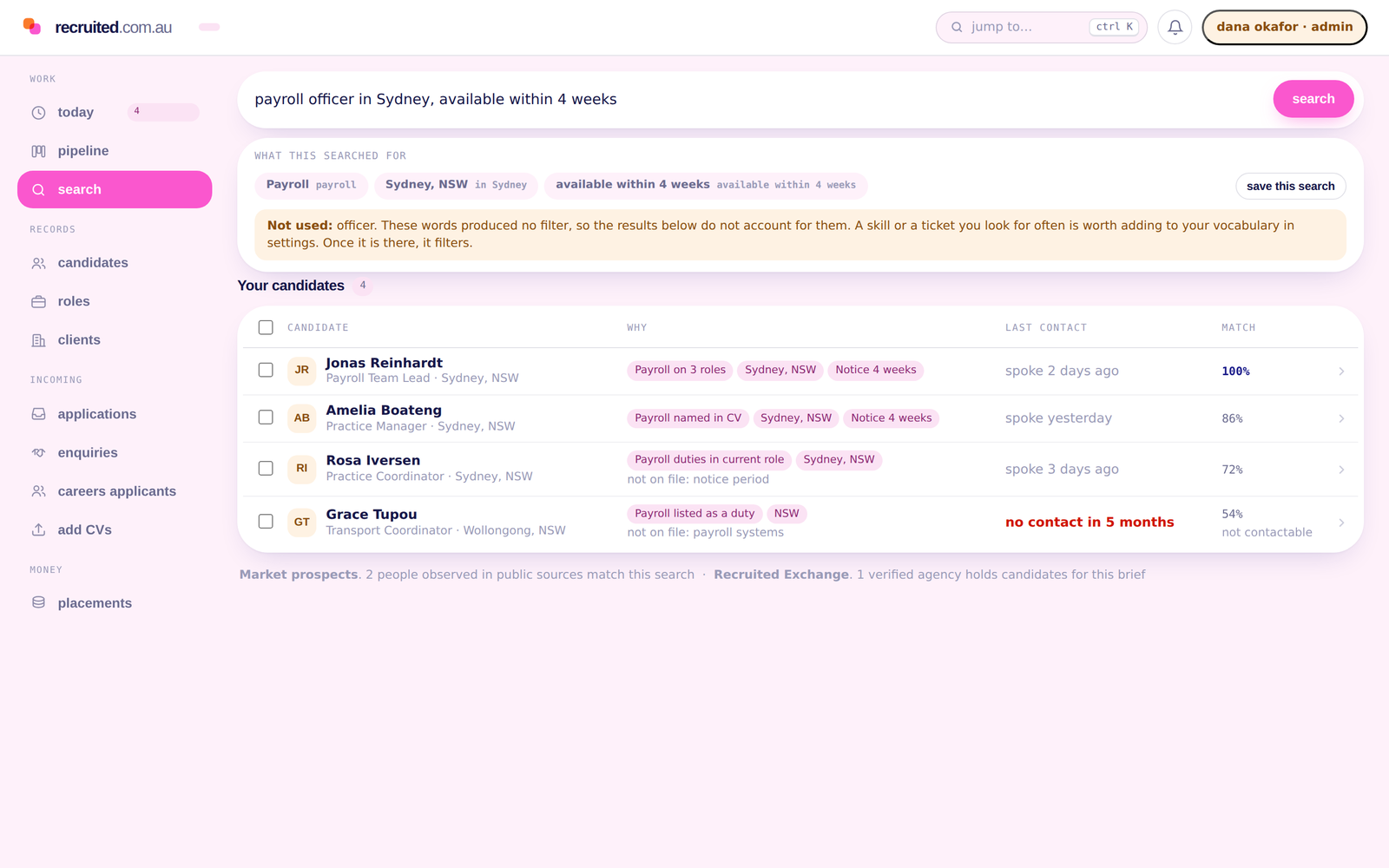
A search committee asks why each name is on the list. The search here is built to answer that: it runs over the records your firm holds, it shows the filters it understood before it runs, and every result carries the evidence it matched on.
-
Your pool, not the internet
Search runs over the candidate records your workspace holds. It does not crawl the web and does not read anything behind a login. Public market signals are a separate capability, kept in a separate space.
-
The question becomes filters you can read
Occupation, seniority, location and radius, skills, work pattern and freshness, each with the words it came from, shown before anything runs and editable.
-
Evidence on every result
Which field or document the match came from, when it was recorded, and what is missing. A gap is named rather than silently ranked lower.
-
No inference about people
No protected characteristic is inferred, scored, filtered on or displayed. Where seniority is inferred from scope rather than stated, the result says so.
The explainable AI search page shows a worked example from question to shortlist.
Deal Desk
Fees, guarantees and the forecast, kept as separate numbers.
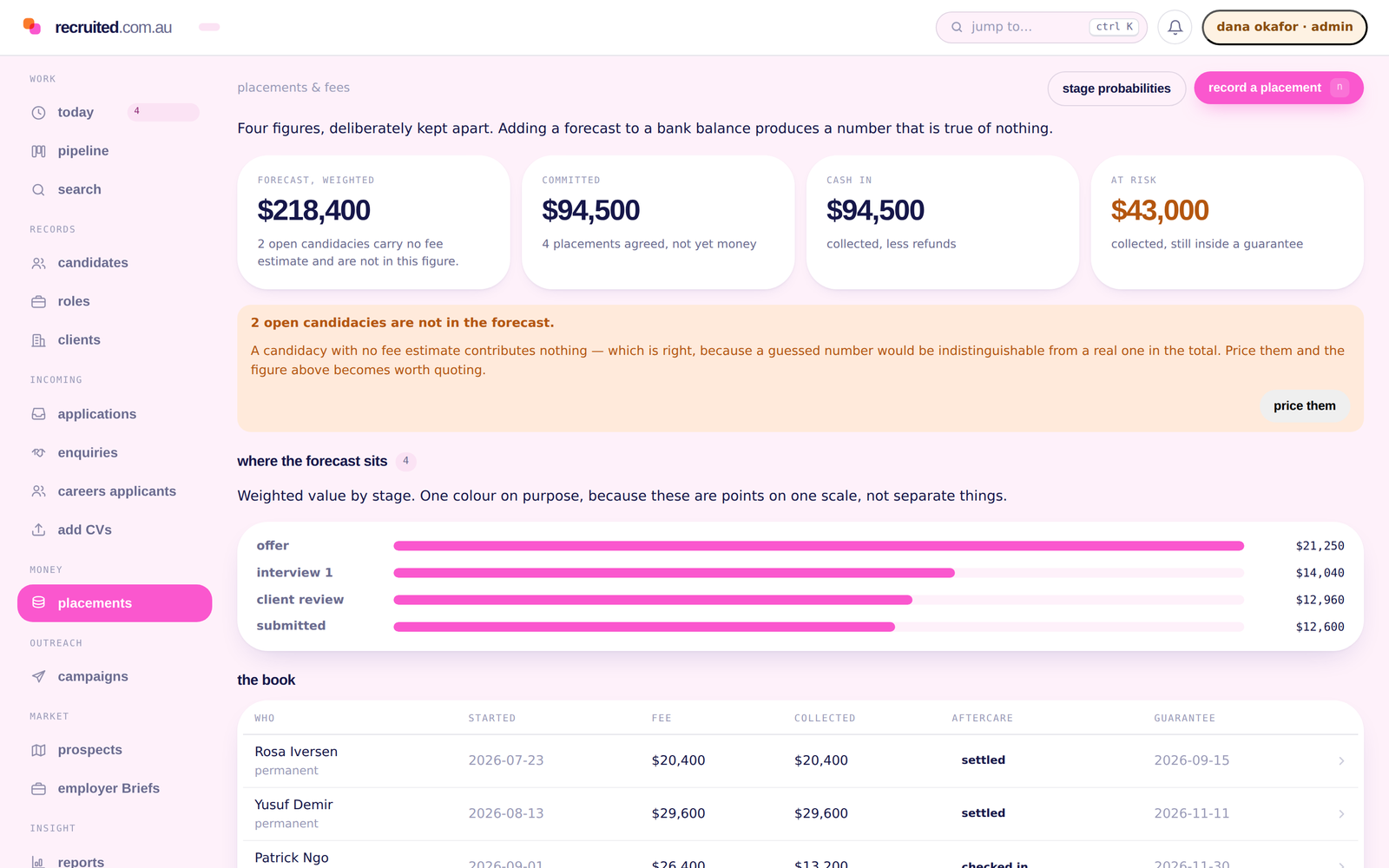
A retained practice lives on a small number of large fees, which makes each one worth tracking properly. The Deal Desk keeps the forecast, the committed fee, the cash collected and the money still inside a guarantee as four figures, and never adds them together.
The fee ledger on every placement
Append-only. A correction is a new event that points at the one it corrects, so what was invoiced, what came in and what went back out inside a guarantee can be read as a history rather than believed as a total.
| Event | What it records |
|---|---|
| Agreed | The fee at placement. Opens the ledger, so the money history starts with what was promised. |
| Invoiced | Each invoice, with its reference and date. |
| Collected | Cash received, with the evidence source recorded. |
| Credited, refunded, written off | Money going back out, stored as negative events rather than overwriting a total. |
| Adjustment | A correction that points at the event it corrects, so the pair is read together. |
-
A fee estimate and a probability, per candidacy
Each open candidacy carries a fee estimate and a stage probability. A partner can override the probability, with a reason and their name attached, and the override is shown as a human judgement rather than absorbed into the system’s number.
-
Guarantee exposure you can see
Fees already collected that could still be refunded if a placement falls over inside its guarantee, listed placement by placement with the date the guarantee ends.
-
Where the ledger begins
The ledger opens when a placement is recorded, with the agreed fee. Retainer instalments invoiced before that point are recorded on the opportunity and the client, in the fee basis and notes, rather than as ledger events.
The fee and guarantee tracking page describes the forecast, the evidence behind each position and the aftercare stages in full.
Plans
Published prices, with the export on every plan.
Every plan includes candidates, clients, contacts and opportunities, the pipeline, the communications timeline, structured and explainable search, the Deal Desk and the full export at any time. Basic is A$249/month, excluding GST, with 1 user included.
Basic
A$249/month, excluding GST. Solo recruiters and very small teams running their whole desk in one place.
1 user included, then A$25/user/month.
Pro
A$599/month, excluding GST. Growing agencies that need scale, automation and continuous sourcing.
3 users included, then A$39/user/month.
Enterprise
From A$1,500/month, excluding GST. Multi-office agencies with governance, integration or SLA requirements.
Negotiated, usually 8 to 10 to begin.
Questions search firms ask
Does Recruited handle retained search as well as contingent?
Both run on the same records. An opportunity carries the fee percentage and the fee basis in your own words, so a retained assignment and a contingent one sit in the same list and the terms are on each one. The fee ledger opens when a placement is recorded, starting with the agreed fee, and then records each invoice, receipt, credit and refund. Retainer instalments invoiced before a placement exists are not modelled as ledger events; they are recorded on the opportunity and the client in notes and fee basis rather than as money events.
How is a confidential search kept confidential?
A role is private by default and is never published unless someone publishes it. A role marked confidential withholds the client’s name from the public page and its structured data, and it cannot be published until approved replacement wording exists. Communications and activity default to internal visibility. A hiring manager sees only the candidacies you have marked visible to their own client, and never the original CV. Everything that happens on a record is written to an append-only activity ledger.
Can a client see the candidates on a search?
Only the ones you have marked visible to them, on roles that belong to their own client. What they receive is redacted text that a recruiter has approved, not the original file, and their feedback arrives as a row for you to act on rather than as a change to your pipeline.
Does the search use outside data?
No. Search runs over the records your workspace holds. A question becomes named filters you can read and edit before it runs, and every result shows what it matched on, when that was recorded, and what is missing. It does not crawl the web, and it does not infer protected characteristics.
What happens to a candidate we did not place this time?
The candidacy closes with an outcome and a reason. The candidate record stays, with the timeline, the reason and their stated preferences, and the date you last spoke to them. A search result shows how long ago that was, so a contact from three years ago is presented as one.
Does it run temp or contract payroll?
No. Recruited is for permanent placement and executive search desks. It records contract placements and their fees; it does not run timesheets or payroll.
What does it cost?
Basic is A$249 a month plus GST with one user included; Pro is A$599 a month plus GST with three users included; Enterprise is from A$1,500 a month plus GST with single sign-on, custom retention policies and advanced audit export. Every plan includes the full export at any time.
Can we bring our history in from another system?
Yes. Import from your current system’s export files yourself, or have us run the migration with you under confidentiality: export, secure staging, a mapping you approve, a dry run with an exception report, reconciliation totals, then cutover. The switching page sets out all six steps.
Executive search
Bring one live assignment and see whether it fits.
A demo on a search you are running now, under confidentiality, tells you more than a workspace prepared earlier. If you are moving from another system, the switching page describes how your history comes across.
We reply within one Australian business day.