AI Search
Ask for the person you need. See why the results fit.
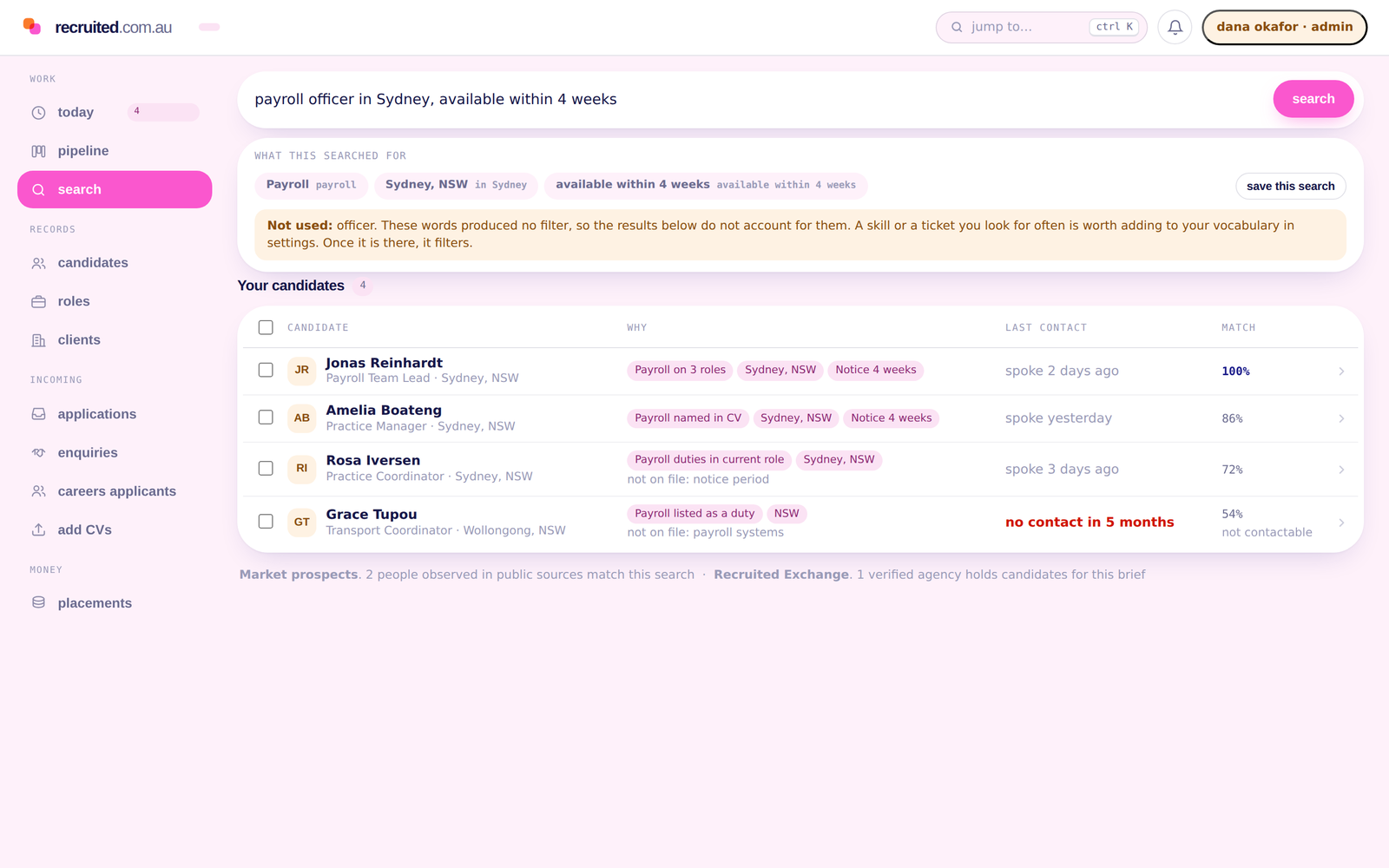
A recruiter’s question becomes filters you can read and edit, and every result carries the evidence it matched on, including what is missing.
What changes
-
The search you meant
You see the filters before anything runs, so a misread question is corrected in two seconds rather than discovered three shortlists later.
-
A shortlist you can defend
Every result comes with the evidence and the date behind it, which is what a client asks for when they push back.
-
Nothing quietly excluded
A candidate missing a field is shown with the gap named, not dropped for a reason nobody can see.
Start to finish
One role, from question to shortlist.
The worked example is a real recruitment problem: a part-time senior bookkeeper in Brisbane with Xero.
-
Ask it the way you would say it
“Find a senior bookkeeper in Brisbane who has Xero experience and is open to four days a week.” No syntax, no field names, no boolean.
-
Read the plan
Occupation, seniority, location and radius, skills, work pattern, freshness and source scope, each with the words it came from. This is the moment to fix “Brisbane” meaning 25km rather than the whole of South East Queensland.
-
Adjust and run
Widen the radius, drop the seniority, add a second accounting package. The filters are the query; changing them is the search.
-
Read the reasons
Each result explains itself: what matched, from where, and when it was last confirmed. Uncertainty is stated rather than hidden inside a score.
-
Save it
A search you will run again becomes a saved search or a pool, so next quarter’s version of this role starts from where this one finished.
The contract
What a result has to carry before it is allowed to rank.
A score with no reasoning looks authoritative and cannot be argued with. A result that cannot show its work does not get to sit at the top of the list.
-
Evidence
The field or document the match came from, so it can be checked in one click.
-
Recency
When that evidence was recorded. A skill confirmed in 2019 is not the same claim as one confirmed in June.
-
What is missing
Named explicitly. “Work pattern not recorded” is more useful than a silently lower rank.
-
Provenance
Which source scope produced it, so a result from a widened scope is never mistaken for one of your own records.
Controls
What it will not do.
The limits are the product.
-
No hiring decisions
It ranks and explains. A person shortlists, submits and decides.
-
No outreach
Finding someone and contacting them are separate actions, and the second one is a person’s.
-
No protected-trait inference
Not inferred, not scored, not filterable, not displayed.
-
No unbounded sources
Source scope is explicit on every search and defaults to your own records.
Related
Questions
Where does it search?
Your workspace, by default and unless you widen it. Source scope is a visible filter, not a hidden setting. The results come from the records your agency holds.
Does it crawl the web or LinkedIn?
No. It does not crawl anything, and it does not read a site’s members-only area. Public market discovery is a separate capability, Opportunity Finder, which keeps a public observation strictly apart from a candidate record.
Can I see and change what it understood?
Yes, before it runs. The question becomes a set of named filters with the words each one came from. You edit them and the search changes with them.
What does “why this matches” show?
The evidence: which field or document the match came from, and when it was recorded. Where something is missing or stale, it says so rather than quietly ranking the candidate lower.
Does it infer anything about a person?
No protected characteristic is inferred, scored, filtered on or displayed. Where seniority or a similar judgement is inferred from scope rather than stated, the result says it was inferred.
Does it contact anyone?
No. Search finds people. Contacting them is a separate, deliberate action by a person, under the consent and preference controls on the record.
Is my data used to train a model?
Not across customers. Retrieval is scoped to what your workspace can see, and your data is not used to train models shared with other customers.
Ready when you are
See Recruited on one of your live roles.
A demo against a real role tells you more than a feature list. Bring one, and we will walk it through the platform with you.
We reply within one Australian business day.