Deal Desk
See what may close, and what needs attention first.
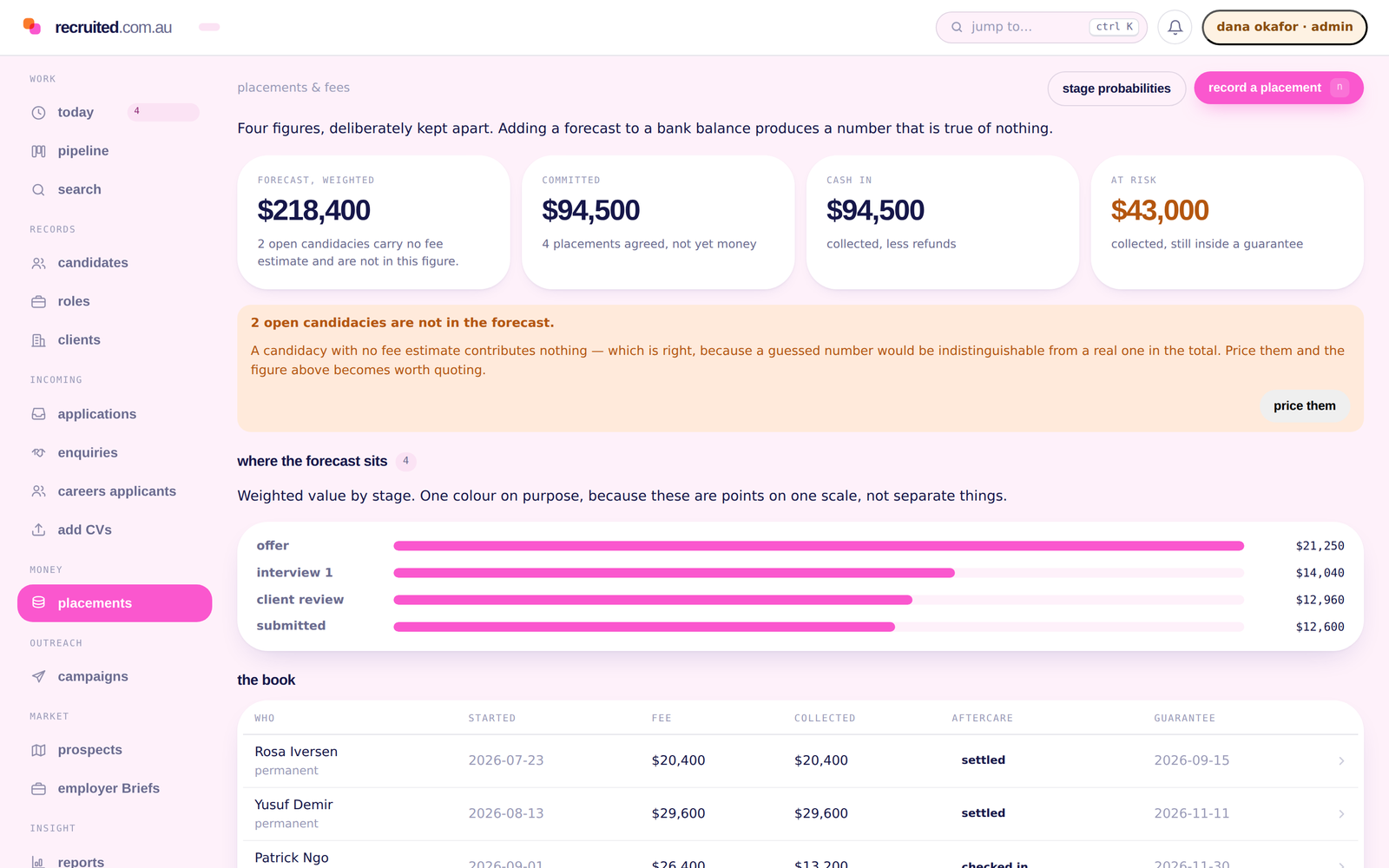
Fees, margins, splits and invoicing on every placement, and a forecast built from what has happened on each opportunity, with the evidence attached.
What changes
-
A forecast somebody can argue with
Each position shows the evidence behind it, so a review meeting is about the roles rather than about whose spreadsheet is right.
-
Risk while it is still fixable
A stale client, an unscheduled second interview, an offer sitting too long, surfaced at the point something can be done.
-
Exposure you can see
Fees at risk and guarantee periods running, rather than a number that only appears when a refund is requested.
Start to finish
A Monday morning.
-
Start with what is close
Opportunities at offer or reference stage, with what is outstanding on each one named.
-
Then what has gone quiet
Client feedback overdue, second interviews unscheduled, candidacies with no next action. Silence is the most common cause of a lost placement.
-
Then the weighting
Stage probability adjusted by evidence. A client who has confirmed a start date is not the same as one who has said “looks good”.
-
Then the exposure
Fees invoiced but unpaid, guarantee windows still running, and placements inside the period where a refund is possible.
-
Then one next action each
A forecast that does not end in a list of things to do is a report, not a desk.
Controls
Three things kept apart, and labelled.
A guess must never acquire the authority of a measurement, so the three kinds of statement are never blended into one number.
-
System fact
What happened: stages, dates, submissions, offers, invoices. Not adjustable.
-
Human judgement
A recruiter’s override, with their reason attached and their name on it.
-
AI suggestion
A prompt to look at something, clearly marked, never applied on its own.
-
Calibration over time
Stage probabilities are checked against what closed, so the model reflects your desk rather than an industry average.
Related
Questions
Where do the probabilities come from?
Stage probability adjusted by evidence on the specific opportunity, and calibrated against what has closed in your workspace. Not an industry benchmark applied to your desk.
Can I override a forecast?
Yes, with a reason, and the override is recorded as a human judgement rather than absorbed into the system’s own number.
Does it track invoices?
Yes. Fees, splits, invoicing status and guarantee exposure are on every placement.
Is this different on each plan?
The Deal Desk is on every plan. Advanced forecasting and automation are Pro and Enterprise.
Ready when you are
See Recruited on one of your live roles.
A demo against a real role tells you more than a feature list. Bring one, and we will walk it through the platform with you.
We reply within one Australian business day.